Forex for beginners, a practical start plan from the Jeffrey Benson Forex full course
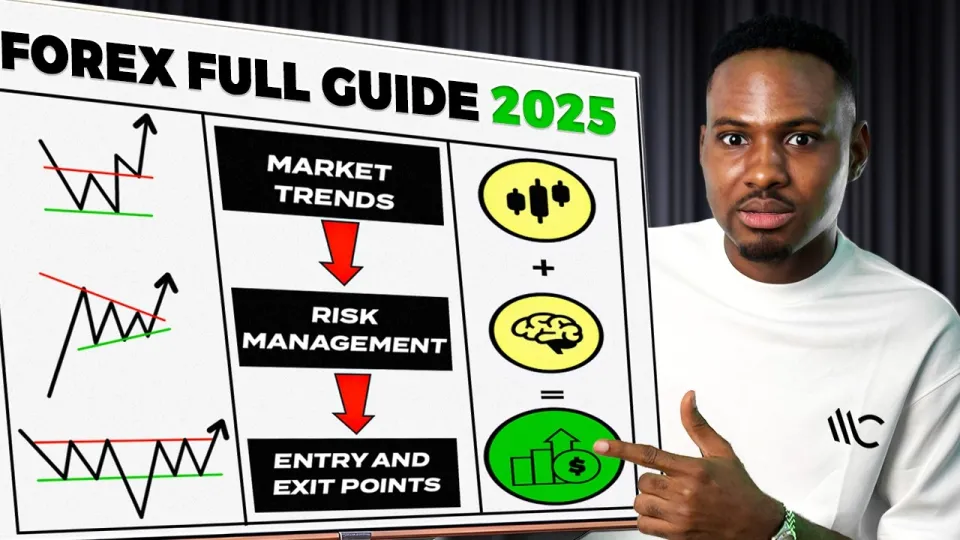
Video: How To Start Forex Trading For Beginners’ 2025 (Full Course)
You can order the same kind of articles for your own video to boost it on YouTube and Google. Just message the Telegram bot @sat_sit_bot. Articles with your video embedded are written and posted by the bot itself — on popular topical sites (no ads). Try it free: 50 articles on us.
· based on the channel Jeffrey Benson Forex
Forex for beginners is the process of learning how currency pairs are quoted and traded, opening a broker account with MetaTrader 5, practising on a demo, and only then risking small amounts with a written risk limit per trade. The full course from Jeffrey Benson Forex follows exactly that order — market basics, tools, strategy, a first trade, mistakes — and the author's paid student programme sits behind the Fire Pips FX plans page.
What forex is and how currency pairs are quoted
Forex is a decentralised over-the-counter market where national currencies are exchanged in pairs, and every quote tells you how much of the second currency buys one unit of the first. The market has no single exchange: banks, brokers, funds and retail traders deal through a network of liquidity providers, which is why prices can differ slightly between brokers and why there is no official closing bell.
A quote such as EUR/USD 1.0850 means one euro costs 1.0850 US dollars. The first currency is the base, the second is the quote currency, and the change in that number is what a trader tries to capture. Three conventions are worth memorising before anything else:
- Pips. For most pairs a pip is the fourth decimal place; for yen pairs it is the second. A move from 1.0850 to 1.0851 is one pip on EUR/USD.
- Lots. Standard size is 100,000 units of the base currency, a mini lot is 10,000 and a micro lot is 1,000. Position size, not courage, determines how much a pip is worth to you.
- Spread and leverage. The spread is the gap between bid and ask and is your first cost on every trade; leverage is borrowed exposure that multiplies both gains and losses on the margin you post.
Majors — EUR/USD, GBP/USD, USD/JPY, USD/CHF, AUD/USD, USD/CAD — carry the tightest spreads and the deepest liquidity. Exotics such as USD/TRY or USD/ZAR move wider and cost more, which matters when a beginner is still learning to place orders accurately.
How the forex market works across four sessions
The forex market runs 24 hours a day from Monday to Friday because the Sydney, Tokyo, London and New York sessions hand over to each other around the clock. Sydney opens the week, Tokyo follows, London is the largest centre by turnover, and New York overlaps London in the afternoon European time — that overlap is typically the most liquid and most volatile window of the day.
Session timing shapes behaviour more than most beginners expect. A strategy tested during the London–New York overlap can behave very differently in the quiet hours before Tokyo, when ranges narrow and spreads widen. Practical consequences:
- Spreads on major pairs are usually tightest when London and New York are both open.
- Economic releases — central bank decisions, CPI, non-farm payrolls — are scheduled events, so check a calendar daily rather than reacting after the candle has already printed.
- Friday afternoon liquidity thins out as desks square positions, which can produce erratic moves into the close.
Tools and accounts a beginner actually needs
A beginner needs five things before risking money: a regulated broker, MetaTrader 5, a demo account, an economic calendar and a trade journal. Everything else — paid indicators, signal groups, extra platforms — is optional and should come after the basics are working.
- Broker. Check regulation and segregation of client funds first, then compare spreads, commissions and minimum deposit. The course author points beginners to Assex Markets and links registration at https://my.assexmarkets.com/auth/register?partner_code=1699134; treat that as his recommendation and verify the licence and terms yourself before funding anything.
- Platform. MetaTrader 5 is the standard: charts, order types, one-click trading and a strategy tester. The author's setup walkthrough is at https://youtu.be/oJ9Cz6dPZw0.
- Demo account. Trade the same instrument, timeframe and position size you plan to use live, for long enough to log at least 30–50 trades. A demo removes financial pressure but not the need for discipline.
- Economic calendar. Free calendars show when volatility is scheduled, so you can avoid opening a trade minutes before a rate decision.
- Journal. Record entry, exit, stop, reason and screenshot for every trade. This is the only reliable way to find out whether a strategy has an edge or whether you were simply lucky.
Building a basic strategy foundation
A basic forex strategy is a written set of rules for direction, entry, exit and size — if any of the four is missing, you do not have a strategy, you have an opinion. The course builds this foundation before showing a single order ticket, and that order is deliberate: execution is the easy part, decisions are not.
A workable beginner template looks like this:
- Direction filter. Pick one pair and one timeframe. Decide trend with a simple structure read — higher highs and higher lows versus lower highs and lower lows — or with a moving average you actually understand.
- Entry trigger. Define one repeatable signal, such as a pullback into a level or a break of a prior swing, and write down what invalidates it.
- Stop loss. Place it where the idea is proven wrong, not at a round number of pips. The distance from entry to stop then drives position size.
- Target and exit. Set a realistic target or a trailing rule, and decide in advance whether you will move the stop to break-even.
- Risk per trade. One to two percent of account equity is the common beginner ceiling; at 1% a losing streak of ten trades costs roughly a tenth of the account, not the account itself.
Position size follows from arithmetic: risk in money divided by stop distance in pips gives the value per pip, which converts into lots. Doing this calculation before every trade is what separates a risk plan from a hope.
Placing a first trade and managing risk
Placing a first trade means choosing the instrument, setting entry, stop loss and take profit on the order ticket, and checking that the resulting risk matches your plan before you click. On MetaTrader 5 the sequence is short, but each field matters.
- Open the pair in the Market Watch window and launch a new order.
- Set the volume in lots that matches your calculated risk, not the default value the platform offers.
- Enter the stop loss and take profit levels; verify the pip distance against your journal plan.
- Check the margin required and the free margin left on the account.
- Send the order and immediately confirm that the stop loss is attached — a position without a stop is an open-ended liability.
Risk management is the part most beginners skip, and it is the part that decides survival. Beyond the per-trade cap, keep total open risk across correlated pairs under control, avoid adding to losers, and accept that a stop loss is a cost of doing business rather than a personal failure. The signal channel the author runs at https://t.me/firepipsignals and the premium group at https://t.me/jeffreybenzhelpbot are best treated as learning material for how setups are framed, not as a substitute for your own risk rules.
Common mistakes beginners make
Most beginner losses come from process failures rather than bad analysis: oversized positions, no stop, revenge trading after a loss and switching strategies before any of them has been tested. The course devotes a dedicated block to these traps, and the pattern is consistent across retail accounts.
- Overleveraging. A large lot on a small account turns an ordinary 30-pip move into an account-ending event.
- Trading without a stop. Hope is not an exit plan; an unattached stop loss converts a bad trade into an unlimited one.
- Strategy hopping. Changing systems after two or three losses guarantees that no sample ever becomes meaningful.
- Ignoring news. Scheduled releases can gap through levels faster than a manual exit.
- Skipping the journal. Without records there is no way to tell skill from luck, and no way to improve deliberately.
Answering the questions beginners ask most
Questions from newer traders tend to repeat: how much money is needed, whether signals can replace learning, and how long the learning curve really is. The honest answers are unglamorous — start with an amount you can lose without changing your life, treat signals as examples rather than instructions, and expect months of demo and small-size work before consistency appears.
Another recurring theme is motivation versus expectation. Testimonials about returning as a millionaire in two years are common in the comments under beginner courses, and they set a benchmark that almost no professional trader meets on that timeline. A more useful target is a written process you follow for 50 trades in a row, with risk capped and every entry logged.
Useful links
- Student programme and course plans: https://firepipsfx.com/plans
- Free daily signal channel: https://t.me/firepipsignals
- Broker registration referenced in the course: https://my.assexmarkets.com/auth/register?partner_code=1699134
- Premium signal group access: https://t.me/jeffreybenzhelpbot
- MetaTrader 5 setup guide: https://youtu.be/oJ9Cz6dPZw0
Bottom line
The Jeffrey Benson Forex full course is a structured beginner path: understand what forex is, learn how the sessions work, set up a broker and MetaTrader 5, build a written strategy, place a sized first trade and avoid the classic mistakes. Its strongest point is order — risk and process come before signals and profit claims. Use the free material to build your own rules, verify any broker and signal service independently, and consider the paid route through the Fire Pips FX plans page only once the basics are working on a demo account.
Key takeaways
- Forex is an over-the-counter market where currencies are quoted in pairs; the first currency is the base, the second is the quote.
- Four trading sessions — Sydney, Tokyo, London and New York — overlap and set the intraday liquidity and volatility pattern.
- A beginner's toolkit is a broker account, MetaTrader 5, a demo account, an economic calendar and a trading journal.
- Risk management comes before strategy: cap risk per trade and size the position from the stop distance, not from the lot you feel like.
- The Jeffrey Benson Forex full course walks through market basics, tools, strategy foundations, a first trade and common mistakes.
Questions & answers
How much money do I need to start forex trading?
There is no fixed minimum, but the amount should be money you can lose without affecting your finances, because beginners typically lose on their first live attempts. A small account is fine as long as position size is calculated from the stop distance and risk is capped at one to two percent per trade. Many brokers accept deposits of a few hundred dollars, though tiny balances limit how realistically you can size positions.
Can I copy someone else's trades instead of learning forex myself?
Copying trades, whether through signal channels or a student programme, can show you how setups are framed, but it does not transfer the risk discipline that keeps an account alive. Signals arrive without your account size, drawdown tolerance or stop rules, so results diverge quickly. Treat them as study material and keep your own written risk limits.
How long does it take to become consistently profitable in forex?
There is no guaranteed timeline, and claims about becoming a millionaire within a couple of years should be treated as motivation, not a plan. A realistic path involves weeks on a demo account, then months of small live size while a journal builds a sample of at least 50 trades. Consistency is judged from records, not from a good week.
Is MetaTrader 5 necessary for a beginner?
MT5 is not the only platform, but it is the most widely supported by brokers and the one used in the course, with charts, order types and a strategy tester in a single application. Learning one platform well is more useful than sampling several. The setup walkthrough linked in the course covers connecting a broker account to the terminal.
Source: How To Start Forex Trading For Beginners’ 2025 (Full Course) · Markdown version